Before a homeowner lets an electrician into their house, they want to know three things: are you qualified, what will it cost, and can they trust you. Landlords and letting agents want a fourth: will the paperwork be right. Here is what your website should answer.
Eight things your website needs
1. Your competent person scheme, with your registration number
Say which scheme you belong to, such as NICEIC, NAPIT or the ECA, and show your registration number with a link to the scheme’s online register. It is the quickest proof that you can certify your own work.
2. A plain explanation of Part P
Most homeowners have never heard of it. In England, notifiable work includes new circuits in kitchens and bathrooms, garden power and a full rewire. A scheme member can self-certify and must notify building control within 30 days, and the customer gets an Electrical Installation Certificate, as council guidance explains. Explaining this in three sentences shows you know what you are doing.
3. A page for landlords and EICRs
Under the Electrical Safety Standards in the Private Rented Sector (England) Regulations 2020, landlords need the installation inspected at least every five years, must give tenants the report within 28 days, and must finish any required work within 28 days, as Sefton Council sets out. A dedicated page with your EICR price, turnaround and what happens if remedial work is found brings in repeat work from landlords and agents.
4. A page for each service
Rewires, consumer unit upgrades, EV chargers, fault finding, extra sockets, outdoor lighting, EICRs. One page each, with what is involved and roughly how long it takes. People search for the job, not for "electrician".
5. Prices, or honest starting prices
A call-out fee, a price for an EICR on a typical flat, a starting price for a consumer unit upgrade. Exact quotes come after a visit, but a starting price filters out time-wasters and builds trust with everyone else.
6. The areas you cover and how fast you respond
List the towns and postcodes you work in. If you offer emergency call-outs, say when and how fast, and only promise what you can actually do at 10pm on a Sunday.
7. Real photos of your work
Tidy consumer units, neat cable runs, finished EV charger installs. Your own photos beat stock images every time, because customers can tell the difference.
8. Insurance and guarantees, stated clearly
Say that you hold public liability insurance and what guarantee you give on your work. Add your Google reviews next to it. Together they answer "can I trust you" before anyone has to ask.
See it working
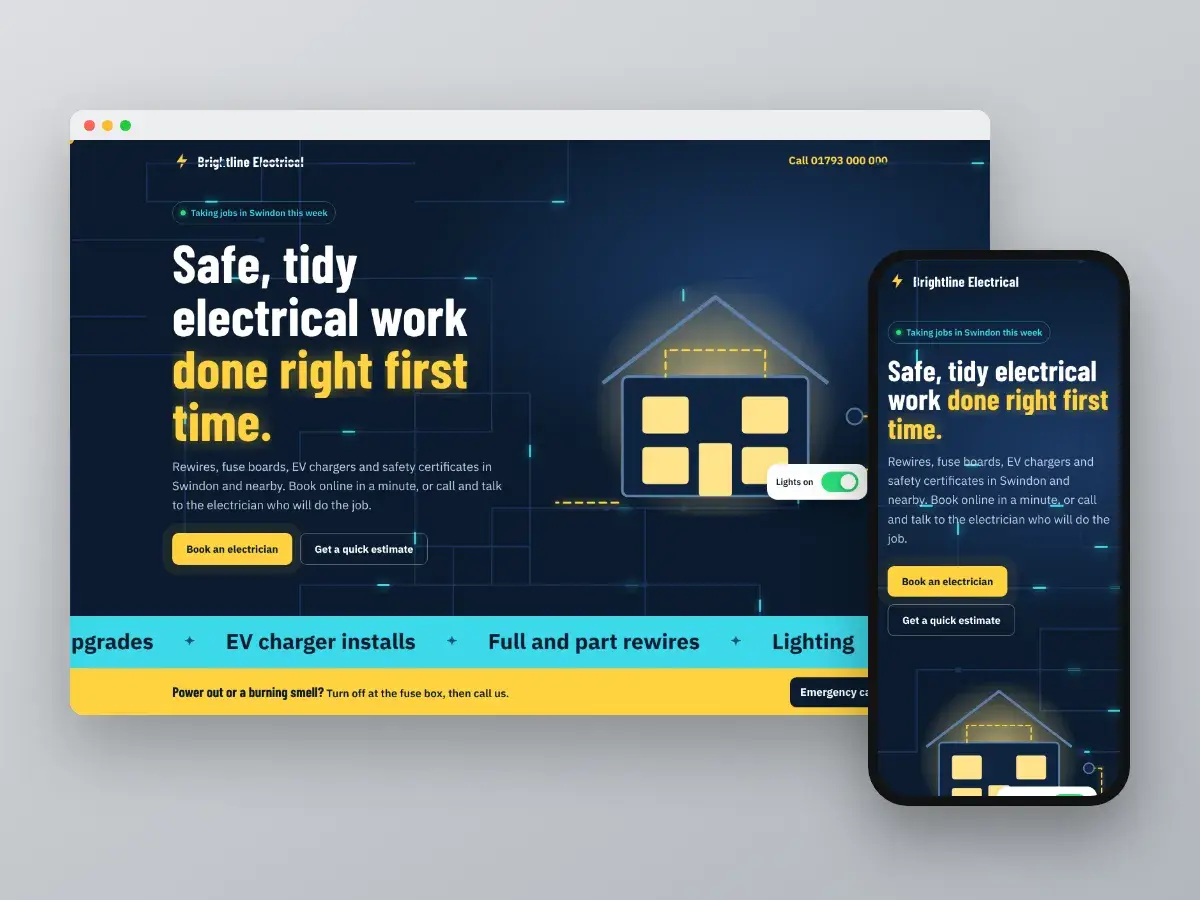
Our electrician demo shows this in practice: scheme details up front, service pages, a landlord section and a quote form built for phones. Open the electrician demo.
Where to start this week
- Add your scheme name, registration number and register link to the header or footer.
- Write a landlord and EICR page with a price.
- Replace stock photos with five photos of your own recent jobs.
- Check your Google Business Profile shows the same areas and hours as your site.
We build websites, booking systems and Google profiles that bring in work for UK businesses. See your homepage design before you commit.